A few years ago, the Public Heritage Studies department at Elizabethtown College was paging through yearbooks from the 1920s when one photo caught their attention. A single African American student, on a mostly white campus, in Lancaster County, a century ago.
“It was sort of a mystery from a photograph,” says Eric Schubert, a historian, genealogist, and member of the Board of Directors at the Historic Preservation Trust of Lancaster County. Schubert was an Elizabethtown undergrad at the time, and because he was a genealogist by trade, he got handed the question. “What can you find out about this person?”
Five years later, that mystery has a name, a legacy, and a lecture series. The student was William “W. Miller” Barbour, and his life ran from a servant’s quarters in Philadelphia to the front lines of the civil rights movement. Lancaster County is where a lot of it began.
The Middletown Trio
Barbour was born in Center City Philadelphia in 1908. Around 1920, the family settled in Middletown, in Dauphin County, and people started noticing Barbour. “Suddenly he appears in the historical record,” Schubert says. The citizens of Middletown threw Barbour a party for graduating high school. “I don’t think they would do that for just about anyone.” He turned up everywhere, civic groups, youth organizations, the works.
Clippings showed he was a done deal to attend Lincoln University in Chester County. Then, without explanation, he enrolled at Elizabethtown College instead. Schubert suspects the answer was simple: he could commute. Barbour and two friends drove in together from Middletown every day, and around campus they became known as “The Middletown Trio.”
A record breaker before anyone was counting
During his time at Elizabethtown, Barbour left an enormous footprint. He won awards on the debate team. He acted in the college’s plays and pageants, often in the lead. One yearbook claimed he had read every single book in the library. He was mentored by the college president himself, Ralph Schlosser, an English professor.
And then there was football. Elizabethtown fielded a team for one year, a squad nicknamed the Brutal 13, and Barbour was on it. That made him the first African American college football player in Lancaster County.
“It all sort of came from a photograph,” Schubert says, still a little amazed at how much that one image opened up.
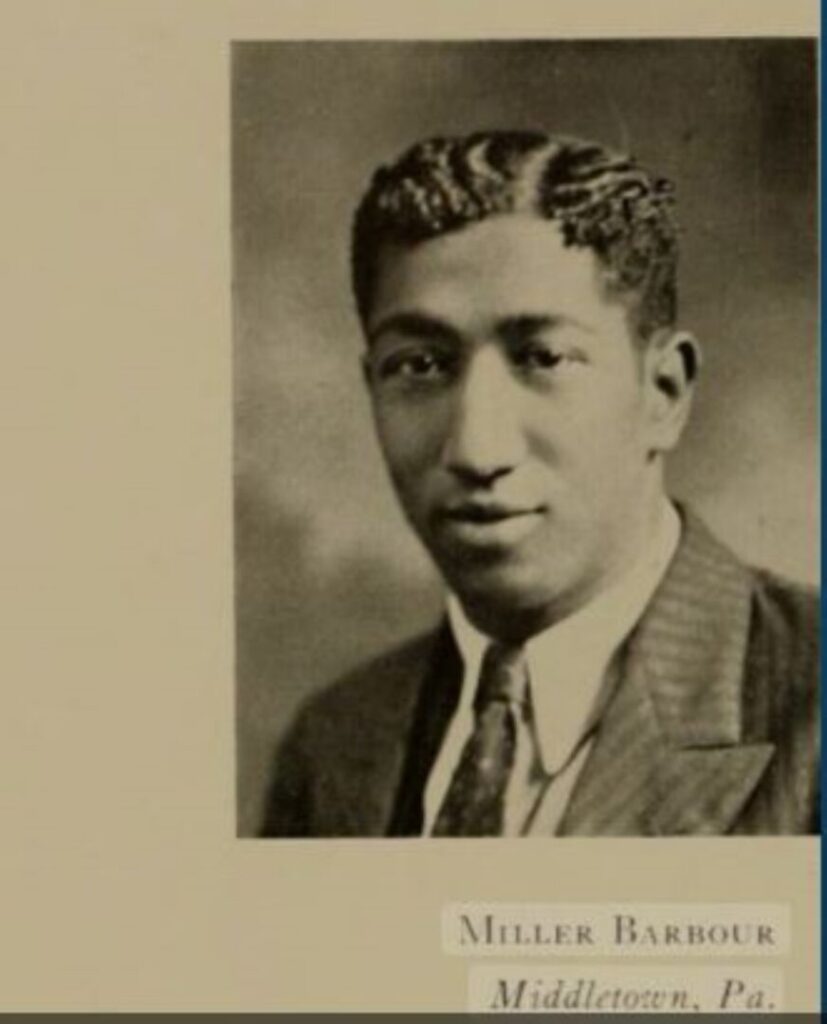
This is the part that matters for Lancaster County. Barbour was not simply enrolled. In a predominantly white institution in the 1920s, he was integrated into the full fabric of campus life, academically, socially, athletically, and publicly. He graduated in 1932 as one of the college’s first African American graduates. These were not marginal roles. Lancaster County was one of the first places his abilities were tested in an integrated setting, and one of the first places he succeeded.
Practical civil rights
Here is the thing to understand about Barbour, according to Schubert: above everything else, he was a highly trained social worker, and that shaped how he approached every cause he took on.
After a short gap, he moved to Philadelphia, earned an advanced degree in social work from the University of Pennsylvania during World War II, and went to work at the city’s Department of Public Assistance. At the historic Wharton Centre, he ran an effort to curb youth gang violence called Operation Street Corner. The name was literal. He would walk up to young men on the corners that everyone else avoided and talk to them.
“I don’t think I would have had the guts to do that,” Schubert says. “But he did.”
That social work lens is what made Barbour different from the leaders who would become household names a decade later.
Barbour focused on two concrete targets: ending segregation and discrimination in employment and housing. He called it human rights, and he argued that true equality was impossible without racial economic justice.
A national career, cut short
In the 1940s, Barbour was plucked out of Philadelphia by the National Urban League, which remains one of the country’s major civil rights organizations today. He became executive secretary, then in 1952 took over the entire West Coast as director of the Western Field Office.
He helped expand the League’s reach across the western United States during a critical period of postwar migration and urban growth, with a relentless focus on housing. In 1948 he was appointed to Denver Mayor James Quigg Newton, Jr.’s Committee on Human Relations. His last major project pushed for desegregation in housing in Victorville, California. He was also ahead of his time as a promoter, hosting galas on social issues with celebrities in attendance, an early version of the celebrity-backed cause campaigns we take for granted now.
Then, in 1957, barely a decade out of his master’s program, Barbour died. He was 49.
“That’s why the story is a sad one, because his work was only just getting started,” Schubert says. Had he lived another five or ten years, Schubert believes Barbour would be remembered in the same breath as the movement’s biggest names. He anticipated the civil rights laws that would later arrive alongside the leadership of Dr. Martin Luther King Jr., but he did not live to see their impact.
How to learn more
Schubert and his colleague, fellow Elizabethtown alum Abigail Sholes, did years of the research that uncovered Barbour’s story, and they have turned it into the W. Miller Barbour Lecture Series, running across Lancaster and Dauphin counties.
Each talk follows the arc of Barbour’s life and career, then connects it to the specific community hosting it. The first Lancaster County date is Sunday, July 19 at Thaddeus Stevens, with another coming in October in partnership with the Historic Preservation Trust of Lancaster County. You can find the full, updated schedule at espublichistory.wordpress.com.
If the name Eric Schubert rings a bell, by the way, you may have caught one of his genealogy talks at Zoetropolis or Southern Market. He is the genealogist who solved the oldest cold case in Pennsylvania, the 1964 Maurice Shiverella case, and he has been featured nationally for that work on Good Morning America. He is drawn to exactly these kinds of stories, the underexplored local biographies that nobody has gotten around to telling.
Barbour’s is one of them. He went to college up the road in Elizabethtown, read every book in the library, played a season of football, won debates, and then went out and tried to build the world those debates were about.