Lancaster County is full strange lore and creepy places, some that you drive past every day. Here are seven of them, from carvings older than the county itself to a shadowy, behatted man a seen by Chickies Rock hikers.
1. Powwow Folk Magic
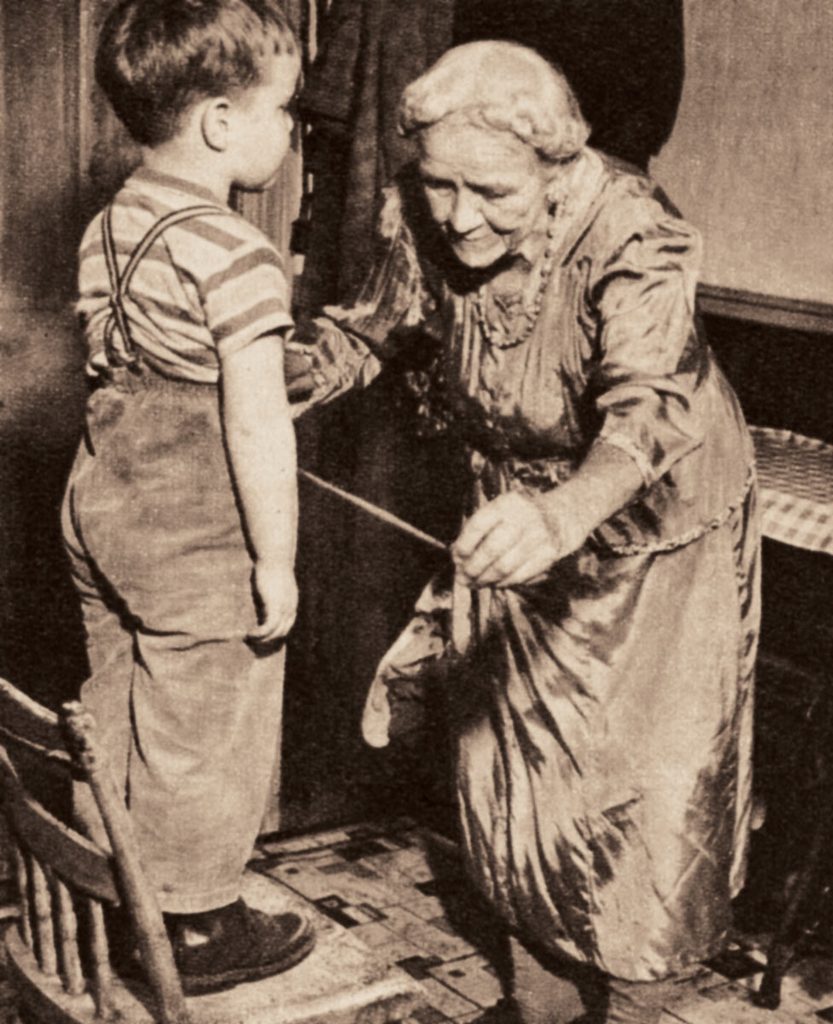
For more than 300 years, some Pennsylvania Dutch families in Lancaster County have been treating warts, burns and sick cows with a kind of folk magic: powwow.
The practice was imported by German-speaking immigrants in the 1600s and 1700s. It has roots in medieval prayers against sickness and witchcraft. A powwower spoke a blessing and worked with ordinary things: a broom, a penny, a piece of string, Lancaster Farming reported. Rainwater caught on Good Friday, or eggs laid that day and eaten before Easter, were meant to keep illness away for a year, says Patrick Donmoyer, author of Powwowing in Pennsylvania.
Some powwowers gained local notoriety. In March 1879, the Lancaster Daily Intelligencer wrote about Hannah Hetherley of Lititz, who healed the sick, told fortunes and led farmers on midnight hunts for a buried chest of gold, guided by charms and old German books, according to Uncharted Lancaster.
In 1928, the dark practice captured public attention. A York County powwower named John Blymire came to believe that another, Nelson Rehmeyer, had hexed him. A woman from Marietta, known as the River Witch, had told him so. Blymire and two teenagers went to Rehmeyer’s farmhouse for his copy of The Long Lost Friend, the standard powwow book, and killed him. The trial in January 1929 drew reporters from across the country, and a jury sent Blymire to prison for life.
2. A Cloistered Cult
In 1732, a German immigrant named Conrad Beissel set out to live a monastic life along Cocalico Creek. His followers came after him. The hermitage became the Ephrata Cloister, one of the first religious communes in America, according to the Pennsylvania Center for the Book.
Members ate one meal a day, in the evening: bread, barley and vegetables. They slept on wooden benches with wooden blocks for pillows, in two shifts, 9 p.m. to midnight and 2 a.m. to 5 a.m. Between the shifts they worshipped, because Beissel believed that if Christ returned, he would come in the middle of the night.
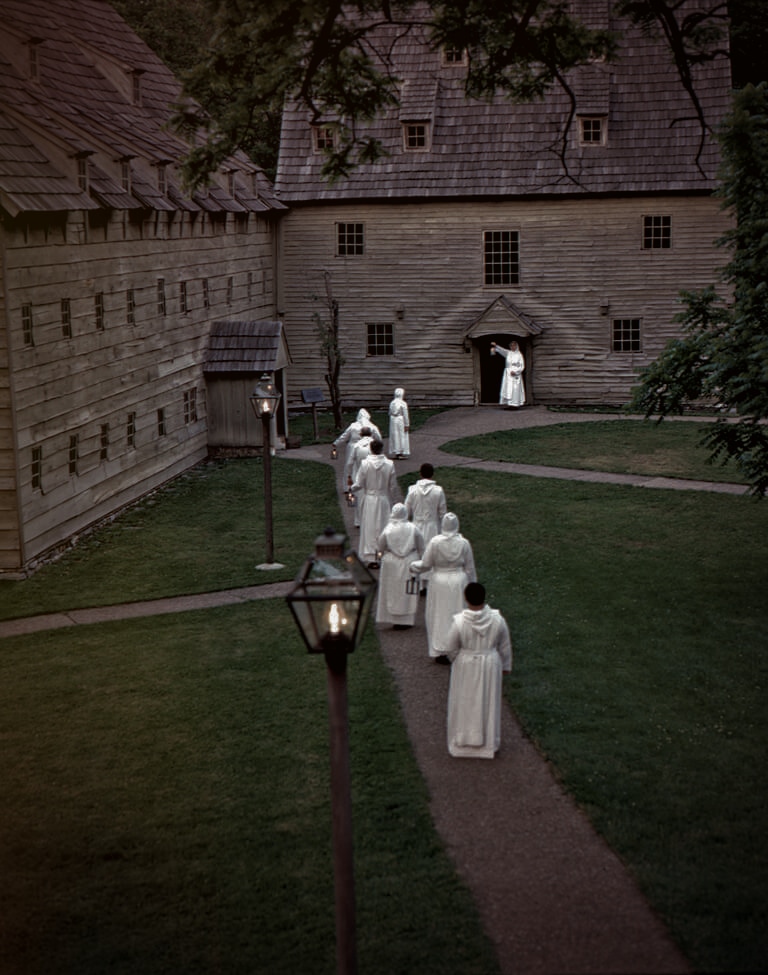
The brothers and sisters wore white hooded robes and took new names. At its peak in the mid-1700s, about 300 people belonged to the community, counting married families who lived nearby; about 80 were celibate, per the Society of Architectural Historians.
Scholars still argue about what the cloister believed. Earlier historians tied it to the Rosicrucians, a secret mystical order. Jeff Bach, in his book Voices of the Turtledoves, argues instead that its roots lay in the German mystic Jacob Boehme. A 2018 article in American Communal Societies Quarterly went further, looking at possible ties between Ephrata’s mystical images and the early Mormon church.
Beissel died in 1768. In 1777, the cloister took in soldiers from the Revolution, and typhoid killed a third of the community. With no children to replace the dead, it never recovered. The last celibate sister died in 1813. Today the Ephrata Cloister is a National Historic Landmark, and its guides still wear the white robes.
3. America’s First Public Crematorium
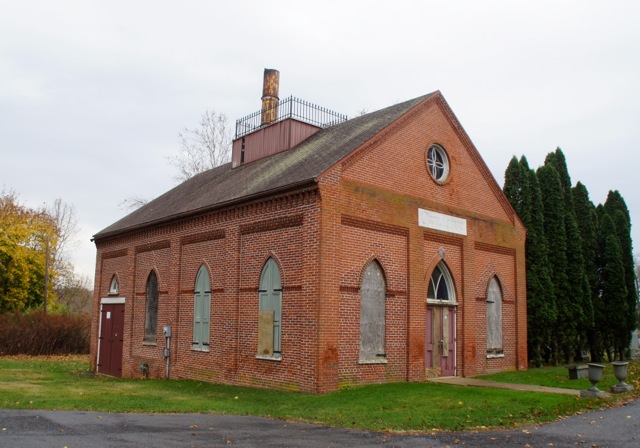
There is a small red-brick building in Greenwood Cemetery with one word carved in marble across the front: Crematorium. It was the first public crematorium in the United States.
On May 27, 1884, a committee of 59 met at the office of the Intelligencer to build it, according to a 2024 history in Contingent magazine. They called themselves the Lancaster Cremation and Funeral Reform Society: doctors, scientists, businessmen and ministers, including educator J.P. McCaskey and publisher A.J. Steinman. Yellow fever was spreading through the Northeast, and they believed crowded cemeteries bred disease.
On Nov. 25, 1884, it cremated Christiana Beseler of New Jersey, whose body had been held for months waiting for the building to be finished. The process took just under an hour. The furnace, designed by Dr. Miles L. Davis, had no chimney. Flues carried the heat and gases about 100 feet, so the building gave off no smoke and no smell.
Today it is boarded up, with no historical marker. The cemetery, at 719 Highland Ave., is open dawn to dusk. You can look at the crematorium from outside, but you can’t go in.
4. Greenwood’s Egyptian Tomb
The Greenwood Cemetery Mausoleum was dedicated in October 1915. Its architect was C. Emlen Urban, who designed many of Lancaster’s grandest buildings. Two years earlier, a Lancaster Daily Intelligencer ad had sold crypts in advance as “Humanity’s Gift to the People of Lancaster.”
Up the hill from the crematorium, at the highest point in Greenwood Cemetery, a granite temple 140 feet long and 40 feet tall looks out over the Conestoga. Two sphinxes guard its bronze doors.
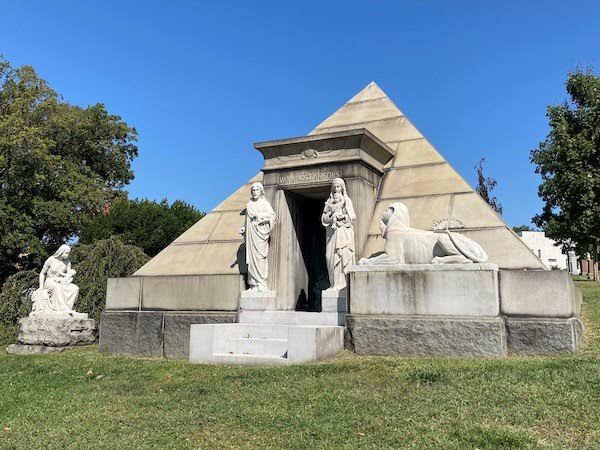
The 1915 dedication report described the inside: 360 crypts along ten-foot aisles finished in Vermont marble, and ten family rooms behind bronze grills. Each crypt had its own vents, and chloride of lime kept down the smell. Crypts sold for $200 to $300. There is no crypt numbered 13. The stained glass mixes old symbols with Christian ones: inverted torches, Christ welcoming a soul, and the River of Life.
It has a twin. Prospect Hill Cemetery in York finished a nearly identical Egyptian Revival mausoleum the same year, sphinxes included; both were built under American Mausoleum Company patents. Prospect Hill gives tours. Greenwood keeps its doors locked, so the closest look you’ll get is through the oversized keyhole. To find it, follow the central drive uphill to the Buchanan Section.
5. Chickies Rock’s Hat Man
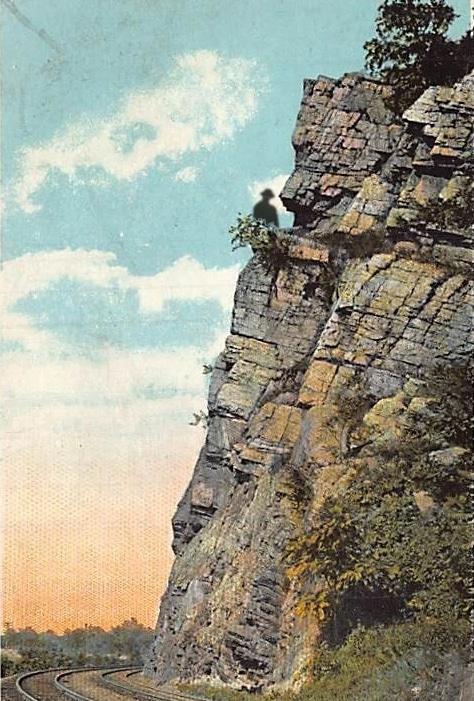
Chickies Rock is a cliff that stands 200 feet over the Susquehanna river between Columbia and Marietta. The name comes from the Lenape Chiquesalunga, place of the crayfish. It’s the cornerstone of a 422-acre county park, and the summit is an easy half-mile walk from the lot on Chickies Hill Road.
Hikers have reported seeing a a tall, shadowy figure at the rock wearing a fedora and a long cape. Some say he is Wanunga, a Susquehannock man from the rock’s oldest legend involving a love triangle that ended in murder and suicide. Others say he stands guard, warning people away from the ground that was sacred long before it was a park. Hikers also report mysterious drumming.
The rock is dangerous even without any ghosts. At least 13 people have fallen from the edge since 1981. So if you go hunting for the hat man, be careful.
6. The Albatwitch
The Albatwitch is said to stand three to five feet tall, covered in black hair, and to live in the trees near Chickies Rock, Lancaster Farming reported. And it wants your apples. The story goes that it drops out of the trees to snatch them from picnickers, and the name is said to come from the Dutch for “apple snitch,” according to the Columbia Historic Preservation Society, as reported by the Shaler Oracle.
The legend is based in both German and Susquehannock lore. Chris Vera, a local Albawitch enthusiast, says sightings go back more than 400 years. And people still report sightings; Uncharted Lancaster wrote about one as recently as 2020. Vera told WITF a friend once saw a creature on a hill behind Columbia, four to five feet tall and pencil thin, that turned and looked at him. Rick Fisher, author of Ghosts of the River Towns, says he saw what he believes was an Albatwitch with yellow eyes.
Since 2014, Columbia has hosted an Albatwitch Day every October.
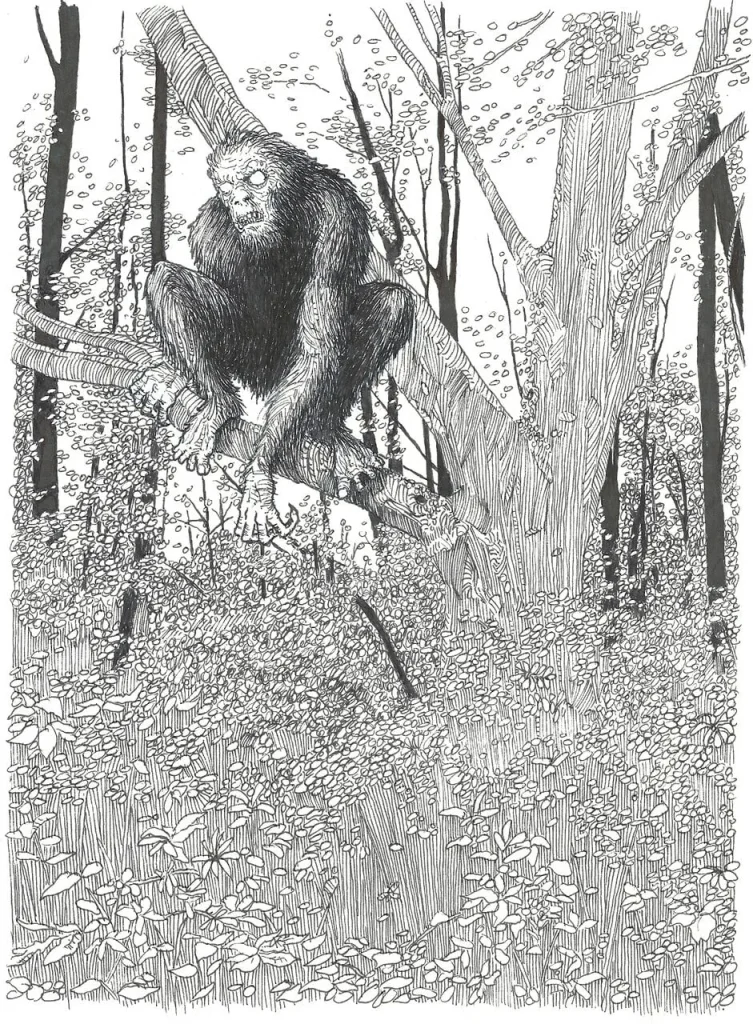
Artwork by “Strange Familiars” podcast creator and host, Timothy Renner.
7. Ancient Petroglyphs In The Susquehanna
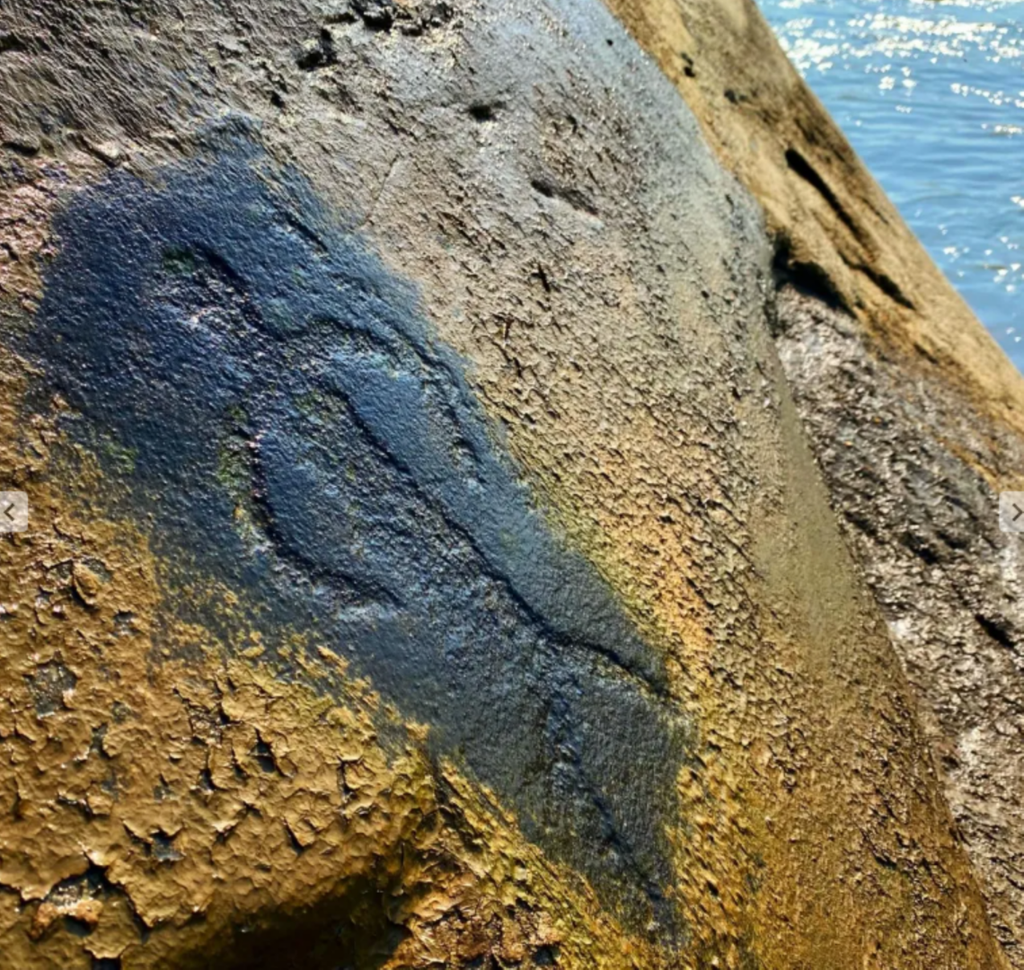
Just below the Safe Harbor Dam, on rocks in the middle of the Susquehanna, someone carved snakes, thunderbirds and human figures into stone.
The lower Susquehanna is home to the largest concentration of petroglyphs in the Northeast, according to the Pennsylvania Historical and Museum Commission: 10 sites and probably more than 1,000 carvings along a 23-mile stretch of river. The state’s archaeologists think most were made by Algonquian-speaking people within the last 1,000 years.
Six of the seven fully carved snakes at Safe Harbor point to where the sun rises or sets on a solstice or an equinox, the PHMC says. On the first day of summer and the first day of winter the sun comes up right where one serpent’s tail points.
To see them, you need a boat and low water. The Susquehanna Greenway’s water trail runs about a mile from the Safe Harbor launch on the Conestoga River to Big Indian Rock. To help preserve the carvings, don’t touch, chalk or trace them.